Cutting Fabric Accurately
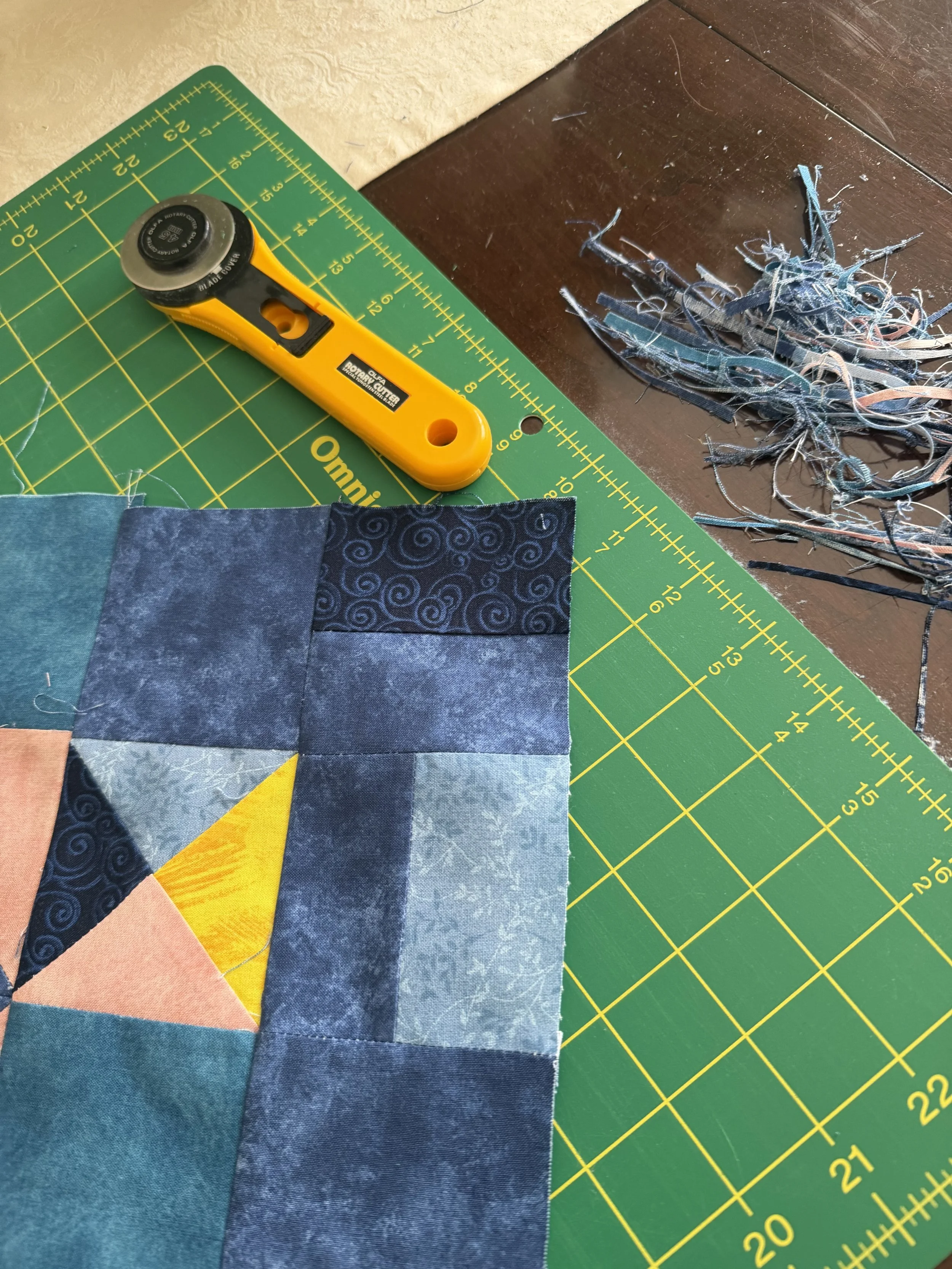
Cutting Fabric
Accurate Cutting is the Foundation of Successful Quilting
Cutting fabric using a rotary cutter, ruler, and mat is one of the biggest hidden hurdles for beginners and seasoned quilters alike. We think we are “doing exactly what the ruler says,” but the issue is usually fabric preparation and alignment before the blade ever touches the fabric. Tiny errors stack up. A bowed strip can easily turn into blocks that are off by 1/8”–1/4", which then creates matching problems later. Clipping off 1/8” of the end of fabric causes seams to not match.
Accurate cutting is the foundation of successful quilting. If the fabric is cut incorrectly, even by a small amount, the pieces may not fit together correctly later. These are some of the things I recommend to make sure my cuts are accurate.
Before You Cut
Press the fabric first.
Wrinkles and folds change measurements.
Press the fabric flat. Lift and lower the iron instead of pushing the fabric across the ironing board. By moving the iron back and forth, this can stretch the fabric.
I usually starch my fabric at this time.
Fold fabric with selvages together.
Match the selvage edges and smooth the fabric gently.
Do not pull or stretch the fabric.
If the folded fabric does not lie flat, the fabric may be bowed or off grain.
Straighten the fabric before measuring.
Place the folded fabric on the cutting mat.
Line up the fold horizontally on a mat line.
Smooth the fabric with your hands so there are no bubbles or wrinkles but do not stretch the fabric.
Squaring Up the Fabric
Trim the first edge before cutting strips.
Place the folded fabric on the cutting mat with the folded edge toward you.
Align the fold with a horizontal line on the mat.
Place your quilting ruler near the uneven cut end of the fabric. Line up one ruler edge with the folded edge and use the mat's grid lines to keep the ruler square with the fabric.
Check three things before cutting:
Fold stays on a horizontal mat line
Ruler vertical line matches the folded edge
Fabric is flat with no wrinkles or lifting
Hold the ruler firmly with one hand and use your rotary cutter to trim off a small amount to create a straight edge away the uneven edge. Cut slowly and smoothly in one continuous motion when possible.
After trimming, check that the new edge is straight and square to the fold. Your fabric is now ready for measuring and cutting strips, squares, or quilt pieces.
Cutting Strips
Example: Cutting a 3" strip
Place the ruler so the 3" line—not the ruler edge—is on the straightened edge of the fabric.
Before cutting, check:
□ 3" measurement touches the edge at the top
□ 3" measurement touches the edge at the middle
□ 3" measurement touches the edge at the bottomHold the ruler firmly and cut with the rotary cutter.
Do NOT move the fabric. Slide the ruler only.
Recheck alignment every few cuts.
Watch for These Common Problems
Problem: Fabric bows or curves in the middle.
Smooth and straighten the folded fabric before cutting. The fold and ruler must both stay aligned with mat lines. Also, don’t cut several layers at a time until you gain experience.
Problem: The last pieces in the strip become too small.
Do not cut the final "smidge" of fabric if there is not enough width left. Measure before cutting. It is better to recut a strip than use an undersized piece.
Problem: Pieces vary in size.
Measure from the newly trimmed edge every time. Do not stack ruler placements or estimate.
Problem: Blocks do not line up.
Accurate cutting + accurate seam allowances = matching blocks.
Remember:
Measure twice. Cut once. Tiny cutting errors become big quilting problems later.
“The mat lines” alone don't guarantee accuracy—the fabric itself has to be squared and aligned.
Don’t just look at the bottom of the ruler only. Physically point to the measurement at the top, middle, and bottom before cutting. That simple habit catches most bowed-strip problems.
Trying to be economical and use every scrap, and using a slightly undersized piece can create much more frustration later than sacrificing a narrow leftover strip.